

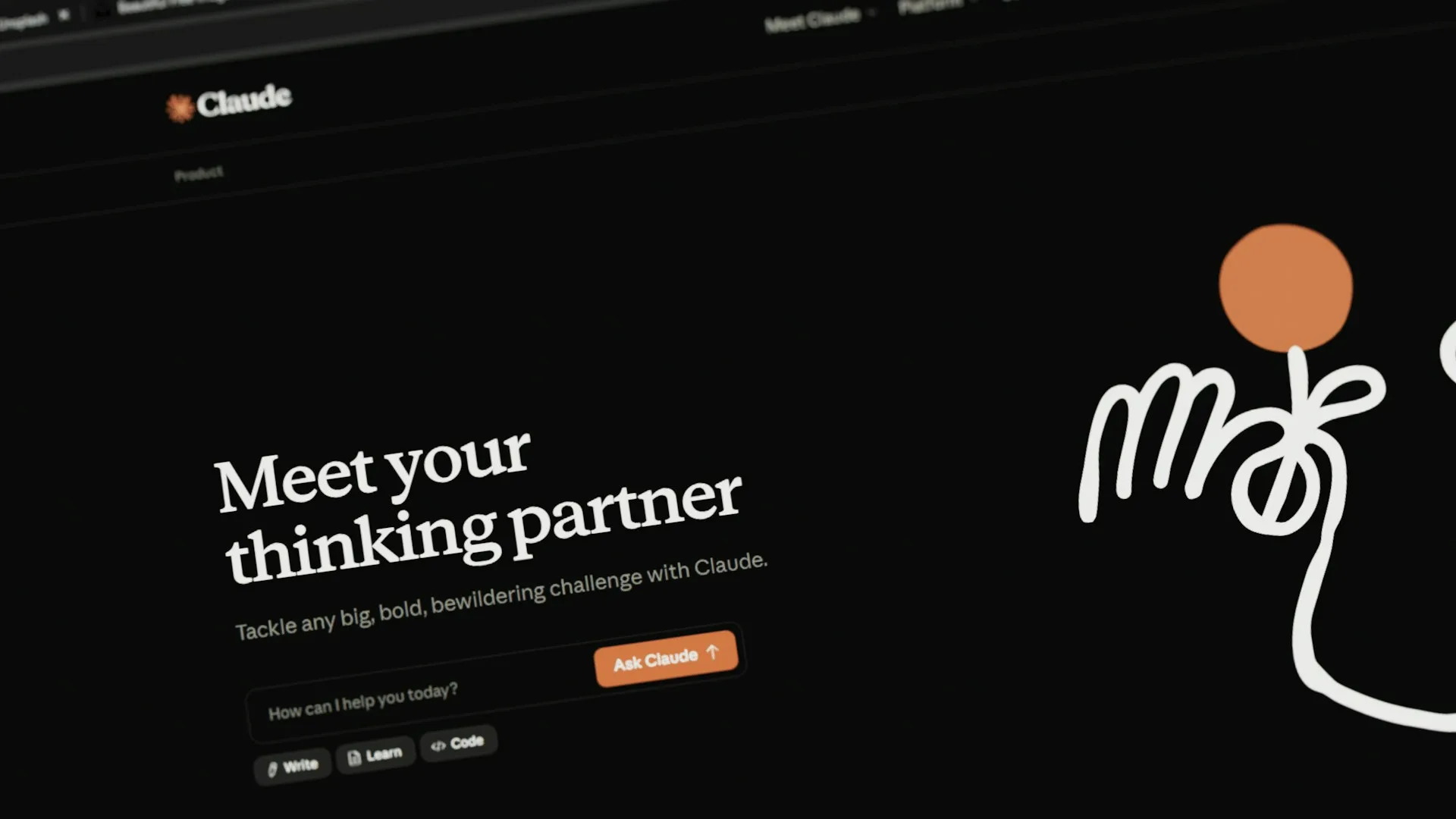
Anthropic has introduced Claude Sonnet 5 - a new model from its mid-tier, „workhorse" Sonnet line. This is an important launch, and not only because the model is faster, cheaper and more powerful than its predecessor. Something else matters more: Sonnet 5 shows where the AI market is heading.
And it is heading from simple chatbots to agents that can plan, use tools, carry out multi-step tasks and work with increasing independence.
For an individual user, that is convenience.
For a company - it's a huge opportunity, but also a new level of responsibility.
Sonnet 5: a model built for agentic work
Anthropic describes Claude Sonnet 5 as the most „agentic" model in the Sonnet line. This means its main advantage is not meant to be simply answering questions better, but carrying out tasks more effectively: planning, using tools, working with a browser, a terminal, code, documents and knowledge processes.
This is an important shift.
In the first wave of generative AI, the user asked and the model answered. Today, increasingly, it is about something more: the user assigns a task, and the model is expected to break it down into steps on its own, carry out part of the work, check the result and drive the process to completion.
Anthropic states that Sonnet 5 narrows the gap to the more powerful Opus models - particularly in agentic tasks, coding, tool use, reasoning and professional work. According to the company, the model's performance approaches Opus 4.8, but at a lower cost.
This could matter a great deal for business. Until now, the most advanced agentic scenarios have often required the most expensive models. If Sonnet 5 genuinely delivers a similar level of execution on many tasks at a lower price, it means more autonomous use of AI could become accessible to a larger number of companies.
What's new in practice?
The biggest change is not a single flashy feature. What matters most is the combination: greater agentic capability, better coding, better tool use, higher cost efficiency and wider availability.
Sonnet 5 is meant to handle tasks that require continuity better. Not just answering a question, but carrying out a series of steps. Not just suggesting a code fix, but checking the bug, writing a test, deploying the change and verifying the result. Not just summarizing a document, but analyzing it in the context of the user's goal.
In Anthropic's materials, partners testing the model describe it in exactly this way: a model that „delivers" on tasks, stalls less often halfway through, and works better in technical, sales, legal, data and process-handling environments.
For companies, this means AI will increasingly move into areas that previously required a human not just as the author of a prompt, but as the coordinator of the entire process.
That does not mean humans stop being needed. Quite the opposite. The more AI carries out tasks, the more important the human role becomes as supervisor, decision-maker and the person who signs off on the result.
Availability and pricing
Sonnet 5 is available across all Claude plans. Anthropic states it has become the default model for Free and Pro users, and is also available to Max, Team and Enterprise users. The model also runs in Claude Code and on the Claude Platform.
In the API, the model is available as claude-sonnet-5. Anthropic launched it at a promotional price of $2 per million input tokens and $10 per million output tokens through 31 August 2026. After that date, the standard price is set to be $3 per million input tokens and $15 per million output tokens.
This positions Sonnet 5 as a model for large-scale work: not the cheapest model for simple tasks, but also not the most expensive Opus-class model. It is more of an „execution layer" for companies that want to use powerful AI in everyday processes, without the costs typical of the top-shelf models.
An important technical note: Anthropic states that Sonnet 5 uses an updated tokenizer. In practice, the same text may be converted into a larger number of tokens than before - according to the company, roughly 1.0 to 1.35 times more, depending on the type of content. This means that for large deployments, it is worth comparing not just the price per million tokens, but also actual token usage in specific processes.
Safety: a powerful model, but not the riskiest one
The most interesting thread concerns safety.
Anthropic states that Sonnet 5 has an overall lower level of undesirable behaviors than Sonnet 4.6 and is safer in agentic contexts. At the same time, the company emphasizes that the model has significantly lower cyber capability than current Opus models.
This is not an accidental message. In 2026, Anthropic came under particular pressure around its more advanced models, such as Fable 5 and Mythos 5. In June, the US government ordered a temporary suspension of access to these models for reasons related to security and export control. Anthropic later reported on restoring access and cooperating with the US administration.
Against that backdrop, Sonnet 5 looks like a model designed as a compromise: very useful for professional work, agentic tasks and coding, but without the level of cyber capability that would raise the same concerns as the most advanced models.
For companies, this is important information. It shows that choosing a model should not rest solely on the question „which one is the most powerful?". In many cases, a better question is: which model is good enough for the task, economical, and appropriate for the level of risk?
Agentic capability means new organisational duties
Sonnet 5 fits into a broader trend: AI is no longer just a tool for generating content. It is becoming a tool for carrying out work.
That changes the rules of the game.
If AI drafts an email, the risk is limited. If AI independently analyzes data, uses tools, accesses systems, makes changes to code, runs workflows or prepares actions for customers, the risk grows.
Questions arise that companies should ask before rolling out such models more broadly:
- who is allowed to launch agentic tasks?
- what data and systems does the model have access to?
- which actions require human approval?
- is the AI's output logged?
- who is accountable for an error?
- do employees know how to oversee AI?
- does the organisation have a policy for using such tools?
These are practical questions, not academic ones.
With agentic models, the problem is not just whether AI gives a good answer. The problem is whether AI takes the right action in the right context.
What does Sonnet 5 mean for companies?
For companies, Sonnet 5 is a signal that advanced AI will become increasingly accessible, both operationally and in terms of price. This could accelerate rollouts in sales, marketing, customer service, IT, data analysis, administration, HR, finance and project management.
But the easier it is to deploy AI, the easier it also is to lose control of it.
If Sonnet 5 becomes the default model for many Claude users, some companies may not even notice that employees have started using a more capable tool than before. From a safety and compliance standpoint, this matters: a model change can alter the scope of possible uses, the level of autonomy, the quality of results and the risk of errors.
That is why every company using AI should maintain at least a basic register of tools and models. It should know whether it uses Claude, ChatGPT, Gemini, Copilot or other systems, in which departments, for what purposes and on what data.
Without that, an organisation is not managing AI. It is only assuming that employees are using it sensibly.
The AI Act and practical readiness
The Sonnet 5 launch is a good illustration of why the AI Act and preparing an organisation for the responsible use of AI keep becoming more important.
Regulation cannot keep pace with every model launch, but its purpose is clear: companies should know when they are using AI, for what purpose, with what risk, and under whose responsibility.
For models like Sonnet 5, three areas will matter in particular.
The first is AI literacy. Employees need to understand how to use AI safely: how to protect data, when to verify answers, where the limits of use lie, and when human oversight is needed.
The second is a register of AI tools. A company should know which models and services it uses, who approved them, and which processes they are cleared for.
The third is assessing vendor and use-case risk. The mere fact that a tool is well known and popular is not enough. You need to understand what data flows into the system, what the terms of use are, what the limitations are, and what happens when the model carries out tasks more autonomously.
Where does AI TrustCERT help with this?
AI TrustCERT helps companies put this exact level of readiness in order.
The point is not for every organisation to immediately build an advanced AI governance lab. The point is to start with the basics: train employees, set rules for using AI, collect acknowledgements, identify the tools in use, assess the first risks, and prepare a readiness report.
The Claude Sonnet 5 launch shows that companies can no longer treat AI as a curiosity. Models are becoming increasingly capable of getting things done, increasingly accessible, and increasingly built into everyday work.
That means organisations need not just access to AI, but also control over that access.
AI TrustCERT helps move from „our people are probably using it somehow" to „we know where AI is being used, who knows the rules, and what evidence of preparedness we have".
Summary
Claude Sonnet 5 is an important launch because it shows that agentic AI is becoming more accessible to ordinary users and companies alike.
The model is meant to be more independent, more effective at working with tools, stronger at coding, and more cost-effective than the most expensive Opus-class models. At the same time, Anthropic strongly emphasizes safety and a lower cyber-capability risk compared with Opus models.
For business, the key takeaway is simple: AI will keep doing more. That is why companies need to know, with increasing clarity, where they use it, what they allow it to do, and how they oversee its actions.
Because the new generation of models is no longer just asking: „what do you want to know?"
Increasingly, it asks: „what should I do?"
Sources
- Anthropic announced Claude Sonnet 5 on 30 June 2026, describing it as the most agentic model in the Sonnet line, capable of planning, using tools such as browsers and terminals, and working autonomously at a level that previously required larger and more expensive models.
- According to Anthropic, Sonnet 5's performance approaches Opus 4.8 but at lower cost, and improves on Sonnet 4.6 in areas such as reasoning, tool use, coding and professional work.
- Anthropic states that Sonnet 5 is available across all Claude plans, by default for Free and Pro, and also for Max, Team and Enterprise; the model is available in Claude Code and via the Claude API as
claude-sonnet-5. - API pricing per Anthropic: promotional $2 per million input tokens and $10 per million output tokens through 31 August 2026; afterwards $3 per million input tokens and $15 per million output tokens.
- Anthropic states that Sonnet 5's safety evaluations showed a lower overall rate of undesirable behaviors than Sonnet 4.6, and significantly lower cyber-task capability than current Opus models.
- In June 2026, Anthropic reported on a US government directive ordering the suspension of access to the Fable 5 and Mythos 5 models, followed later by a newsroom update on their re-deployment.
- Axios described Sonnet 5 as a cheaper model for agentic work, browsing, coding, planning and knowledge work, positioned as a safer alternative to the more advanced Opus and Mythos models.
This article was written with the help of artificial intelligence and reviewed before publication by the author, who takes editorial responsibility for it.